Project Summary
The William Rogers Project is located 60km southwest of the historical Au mining town of Croydon within the underexplored Croydon Province of North Queensland and consists of a single granted Exploration Permit for Minerals (EPM 27264) covering 117km2. The project is primarily considered prospective for intrusion-related Cu-Au or a hybrid iron sulphide Au-Cu deposit; potential also exists for Broken Hill Type mineralisation.
While the Croydon province has a long history of mining, the region is poorly explored in areas where Proterozoic basement is obscured by younger cover. The geological age, and setting, of the region is considered similar to the Hiltaba Igneous Suite in South Australia that hosts giant deposits including Olympic Dam, with several large scale, mantle tapping features identified in Government funded seismic surveys nearby. Notably, William Rogers lies within the hanging wall of one of these regional scale faults.
The project was identified by MRG in 2019 during interpretation of Geoscience Australia’s AusAEM data with a series of magnetic features strongly coinciding with a large basement conductive anomaly. The magnetic-conductive target – named the William prospect – was interpreted to lie beneath c. 100m of sedimentary cover and extends to depth.
During 2020-2022, a detailed airborne magnetic-radiometric survey and the drilling of a single hole to 279.3m was undertaken at William Rogers under a now expired option agreement between MRG and a private exploration group. Initial magnetic modelling suggested a steeply northeast dipping magnetic body occurs at William with drill hole, MB21DD01, designed to test the feature.
Basement in MB21DD01 was intersected at 74m downhole depth and from c. 95m to end of hole the dominantly biotite-muscovite schist and psammitic schist lithologies were cut by extensive, multiphase quartz-carbonate-sulphide veins that show crackle brecciation and increase in frequency down-hole. The vein system returned strongly anomalous geochemistry with peak 2m composite values of: 0.106g/t Au, 293ppm As, 18ppm Bi, 277ppm Cu, 13.5% Fe, 14ppm Mo, and 234ppm Zn. Importantly, the vein system lies subparallel to the drill core indicating the system dips c. -60° southwest rather than steeply northeastwardly as suggested by initial magnetic modelling.

A post drilling review of the project by MRG highlighted the likelihood of magnetic remanence complicating interpretation at the William prospect with both northeast and southwest dipping features able to be modelled. Given the vein system observed in drill core, it is considered likely that the southwestwardly dipping model is the more accurate suggesting the William target remains poorly tested. The review also highlighted prospectivity at the nearby Peter (T2), Gwen (T3), and James (T4) prospects.
In 2024, an earn-in agreement for the William Rogers Project was signed with a wholly owned subsidiary of South 32 Ltd. Under this agreement, initial exploration is planned to include moving loop electromagnetic surveying to refine targets across the project ahead of follow up drill testing.
-
 Figure 1: Project Location.
 -
 Figure 2: Detailed TMI RTP magnetics showing the William (T1), Peter (T2), Gwen (T3), and James (T4) prospects, past drill holes, and GA’s AusAEM flightline.
 -
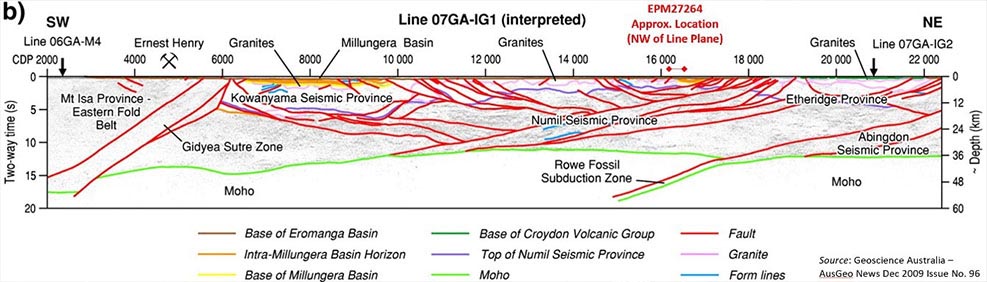 Figure 3: Crustal architecture along seismic line 07GA-IG1.
 -
 Figure 5: Remodelling of magnetics shows both northeast and southwest dipping magnetic bodies are possible at the Momba target; quartz-carbonate-sulphide veins subparallel to drill hole, MB21DD01, suggest the southwest dipping model is more accurate with the target remaining poorly tested.
 -
 Figure 4: Initial magnetic modelling at the William prospect suggested northeast dipping bodies from which drill hole, MB21DD01, was planned.